EN

Curtain
by
Willem de Haan
Up top of the staircase of Villa, bright yellow tape measures hang suspended like a Curtain (2022). You can't help but pass through this playful portal, swaying gently in a wall of colour and movement. Usually solitary and functional, the everyday object is transformed here into part of a larger visual rhythm. Almost begging to be pulled (but please don't), it resists your grasp. A reminder that this is a space to observe, not to handle. The work is amusing, while inviting reflection on scale, measurement and the hidden poetry in the ordinary.
Year | 2022 |
Type | sculpture |
Material | steel frame, tape measures |
Work in Progress


First conceptualized for TTHQ in Rotterdam, the work responded to the exhibition requirement of including a curtain to divide Team Thursday's graphic design workshop from the exhibition space. By rolling the tape measures in and out, various shapes could temporarily be left out of the curtain. Next to a fireplace that caught fire, and a prophetic piece of paper, the work was on view in 2022.
“I never choose myself what a work of mine will look like. I look at something that already exists. By relocating it, it gains a different meaning.”
Willem alternates between the precision of a carpenter and the humour of a prankster. His ideas are ambitions in scale and in realism – but the artist is aware that his work needs to trick the eye, and therefore needs to be assembled with meticulous care. All his work requires physical labor and craftful skill – through which a tape measurer is an ordinary object he holds in his hand every day. Measuring twice is unavoidable. For his work at Villa, Willem happily admitted that after ordering 500 tapes to his studio in Antwerp, he finally always had a measure at hand.
Trivia
By rolling the tape measures in and out, various shapes can temporarily be left out of the curtain.
How tall are you?
About Willem de Haan
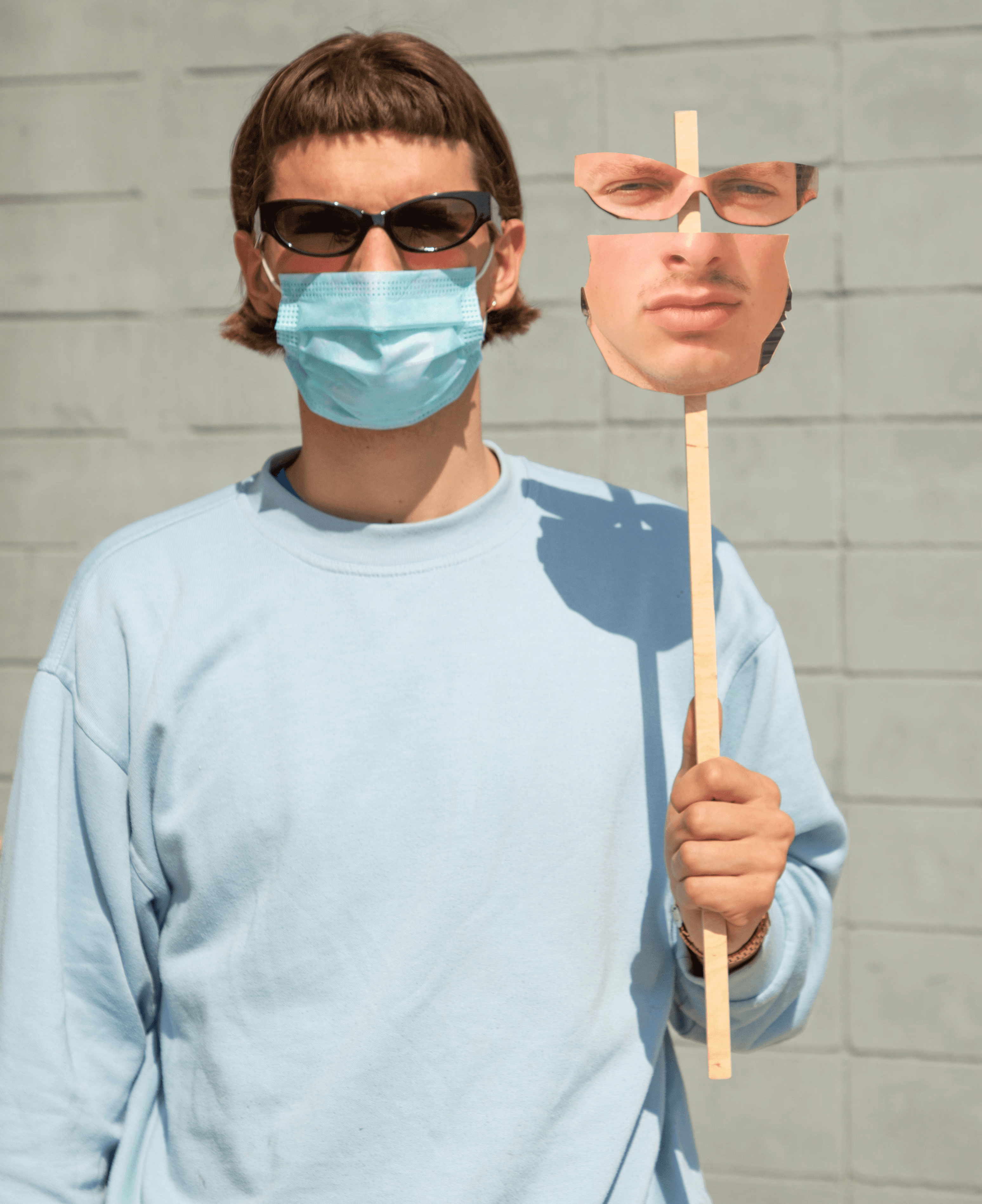
Willem de Haan (1996) brings subtle absurdity to everyday life. A floating roof. A swing without a seat. A metro station in the middle of nowhere. His work pokes fun at the rules of public space, adding slightly absurd sculptural interventions to distort our experience of daily life. Inspired by fiction and film, but rooted in reality, Willem creates scenarios that feel both believable and surreal. His work is visually striking, playful, and site specific – provoking curiosity, delight, and reflection.
Among the youngest of his class to graduate in Fine Art from ArtEZ University of the Arts (2017), Willem has since realized public projects internationally, including Rotterdam, Vienna, Barcelona, and Houston. In 2025, he was awarded with the Emerging Talent Award of Dutch Design. After spending the last years based in Belgium, as of recently Willem lives and works in Amsterdam.
Tilting the World with a Measuring Tape
Over het werk van
Willem de Haan
Long yellow measuring tapes hang down from the ceiling. In Villa, the row of tape measures together forms a curtain of slats. By rolling the tapes in and out, different shapes can temporarily be cut out of the curtain.
Curtain was made by artist Willem de Haan. It seems so simple, a row of tape measures forming a curtain — but try and come up with it yourself. This is actually the thought that often comes to mind when you encounter Willem’s work. His pieces often explain themselves: by looking, you can grasp them, and in doing so Willem plays with our gaze. With how we look at things. At the same time, “understanding” is not really the case. His artworks keep redefining themselves in different ways. He shifts reality with a small intervention, leaving the viewer with a smile.
His work takes many forms: sculptures, photos, videos. He often gets ideas in public space. In a recent interview on Radio 1 he explained: “Often something strange is going on and, as a tribute to the existing situation, I add something to it.”[1]
Shifting the way we see reality always comes with the question of what is real and what is staged. And as a viewer, you can never fully put your finger on the meaning. His works are a kind of game with constantly different outcomes. The 2018 photograph Beach Day is a good example. In the photo, a woman lies on the beach on a summer’s day. In front of her stands a man with a protest sign bearing a printed cloud. The sky is clear blue, the sun blazing. The big sign casts a perfect shadow on the woman. The work can be read in different ways: the protest sign as an expression of someone who cannot stand the perfect beach weather. Or perhaps the woman hired someone to bring her shade. “The doubt you have as a viewer, where you’re not sure what has been staged, I find very attractive,” he said in the same radio interview.[2]
Measuring
Curtain is literally about measuring. About dozens of centimeters that together make a curtain. The idea of measurement and scaling reality appears in his work often, sometimes in less direct ways. In his solo exhibition Before The Scenes at gallery Vriend van Bavink in 2023, he presented replicas of pieces of five different artists’ studios. He visited them with a camera and measuring tape and selected roughly one square meter of studio to recreate in detail. Not only the floor and wall but also every single object on it was reproduced. In the gallery, visitors saw stark cutouts, as if the fragments had been sawed straight out of the studios. Each square meter also contained an original artwork by the “portrayed” artist, which could be bought together with the reconstructed studio fragment. The square meter became a glimpse into the art-making process.
That exact unit of one square meter also reappeared in the sales price. The sculptures were sold based on the square meter price of the street where the artist’s studio was located.
Relocating environments
In Curtain, Willem gives an everyday household object an entirely new function. By doing so, he makes us look at it differently — as with Curtain, where the sliding motion of the tape measure suddenly takes on a new emphasis. In an interview with Het Parool in 2023, he said: “I never choose myself what a work of mine will look like. I look at something that already exists. By relocating it, it gains a different meaning.”[3]
This method recurs throughout his practice. For the IJssel Biennale in Overijssel, he transported an exact replica of the Rotterdam metro station Delfshaven to a meadow, surrounded by a few solitary farmhouses.
This act of displacement and inversion is not only a humorous gesture. Willem also wants to provoke new ways of thinking about things we take for granted. In the Spanish city of Logroño, he placed a Spanish house inside a fountain. The fountain had once held a statue of the Spanish general Espartero, which dominated the public square. Willem asked himself: isn’t such a vast space, dedicated to a single person, essentially like private property? From this thought, he replaced the colossal pedestal with a modest Spanish house. The house added a human perspective to the monumental representation of this historical oppressor. By “privatizing” the monument, Willem also literally added a bridge across the fountain. For the first time in the monument’s 130-year history, the bridge gave residents and visitors of Logroño public access to their own square.
In this public space, he placed a private space that instead became public, welcoming local residents. On the garden table sat books about Espartero, Spanish independence, Peruvian independence, the Carlist Wars, and the bombardments of Barcelona.
Willem brings both large and small themes to light in his work. Flipping reality with humor requires a sharp eye. He seems constantly aware of the world outside on the street, looking and looking, letting ideas form. In the same Radio 1 interview, he explained that as a child he was trained in observing reality visually and describing it, because he grew up with a blind mother. “I was always used to continuously describing what I saw.” When he was five and had just learned to count, he remembers taking the bus with her: “She had to ask me: two buses are arriving, numbers three and four. Which one is bus three? That way you get very used to constantly describing what you see — because you’re not only your own eyes.”[4]
[2] Idem