EN

The Mother (The Bobby in Me)
by
Vera Gulikers
In The Mother (The Bobby in Me) (2024), Vera Guliker's sculptural alter ego sways her newborn child. Her legs curve protectively over the infant, guiding the viewers eye into a dance of loops and tangles. The bow they form is both playful and symbolic: it may refer to a child as a gift that unwraps itself. The twisting figure embodies the paradox of motherhood: closeness and separation, giving and receiving, holding and letting go.
The sculptural self-portrait stands in contrast with two of Vera’s Threadingcanvases, a series in which she directly references art historical paintings.In The artist and her model Geneva, Marie Louise Breslau (1921) and Portrait of Carl van Vechten, Florine Stettheimer (1922), overlooked female painters reflect on work. The velvety flocking that textures the paintings matches the surface of the sculpture, linking the three works into an installation. Together, they explore the dual aspects of Vera’s experience: the artist as mother and the artist at work.
Title | The Mother (The Bobby in Me) |
Year | 2024 |
Type | sculpture |
Material | flock on acrylic resin |
Title | Threadingdoek: Portrait of Carl van Vechten, Florine Stettheimer |
Year | 2019 |
Type | painting |
Material | puff ink and flock on canvas |
Title | Threadingdoek: The artist and her model Geneva, Marie Louise Breslau |
Year | 2021 |
Type | painting |
Material | puff ink and flock on canvas |
Work in Progress
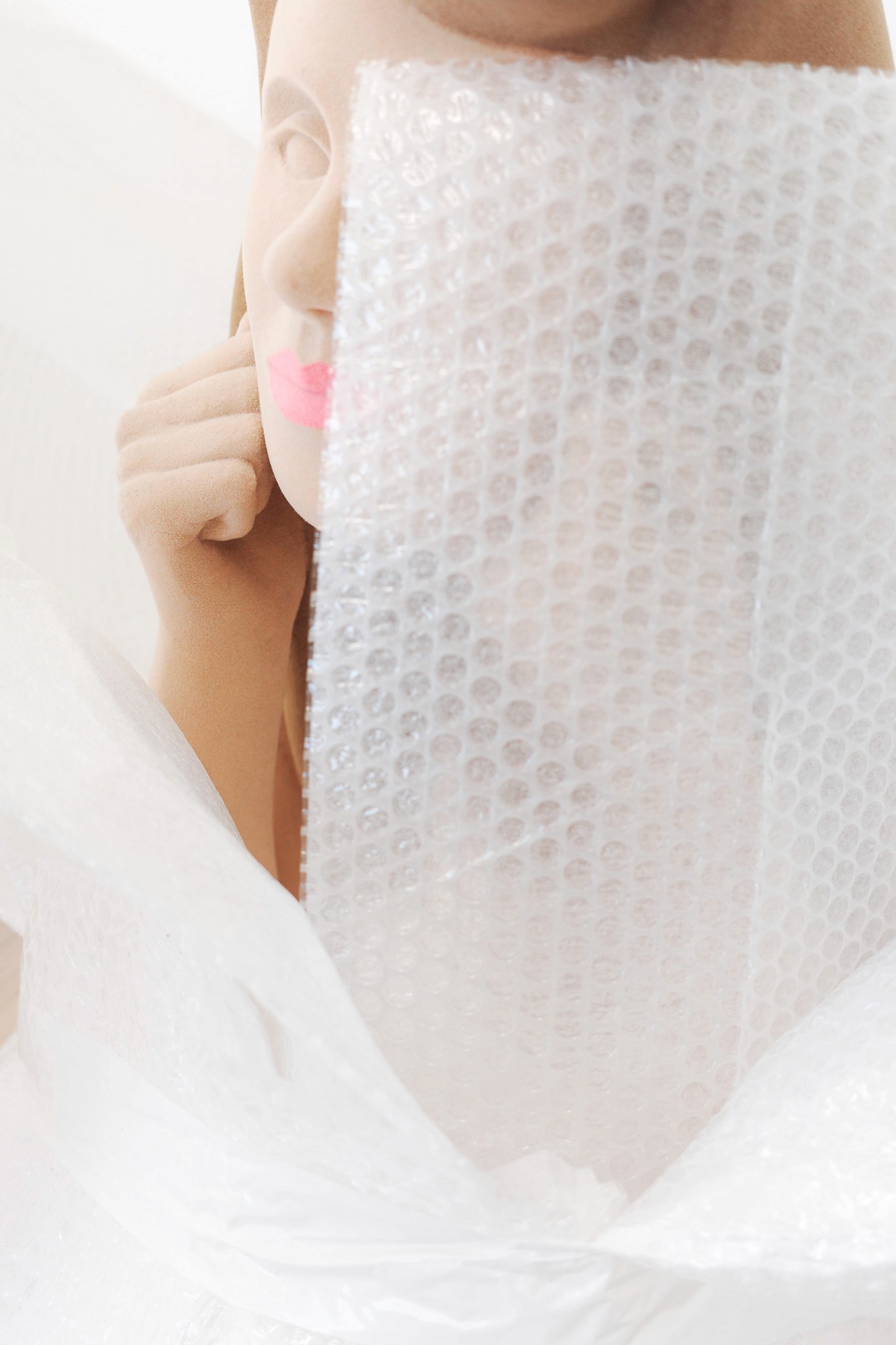
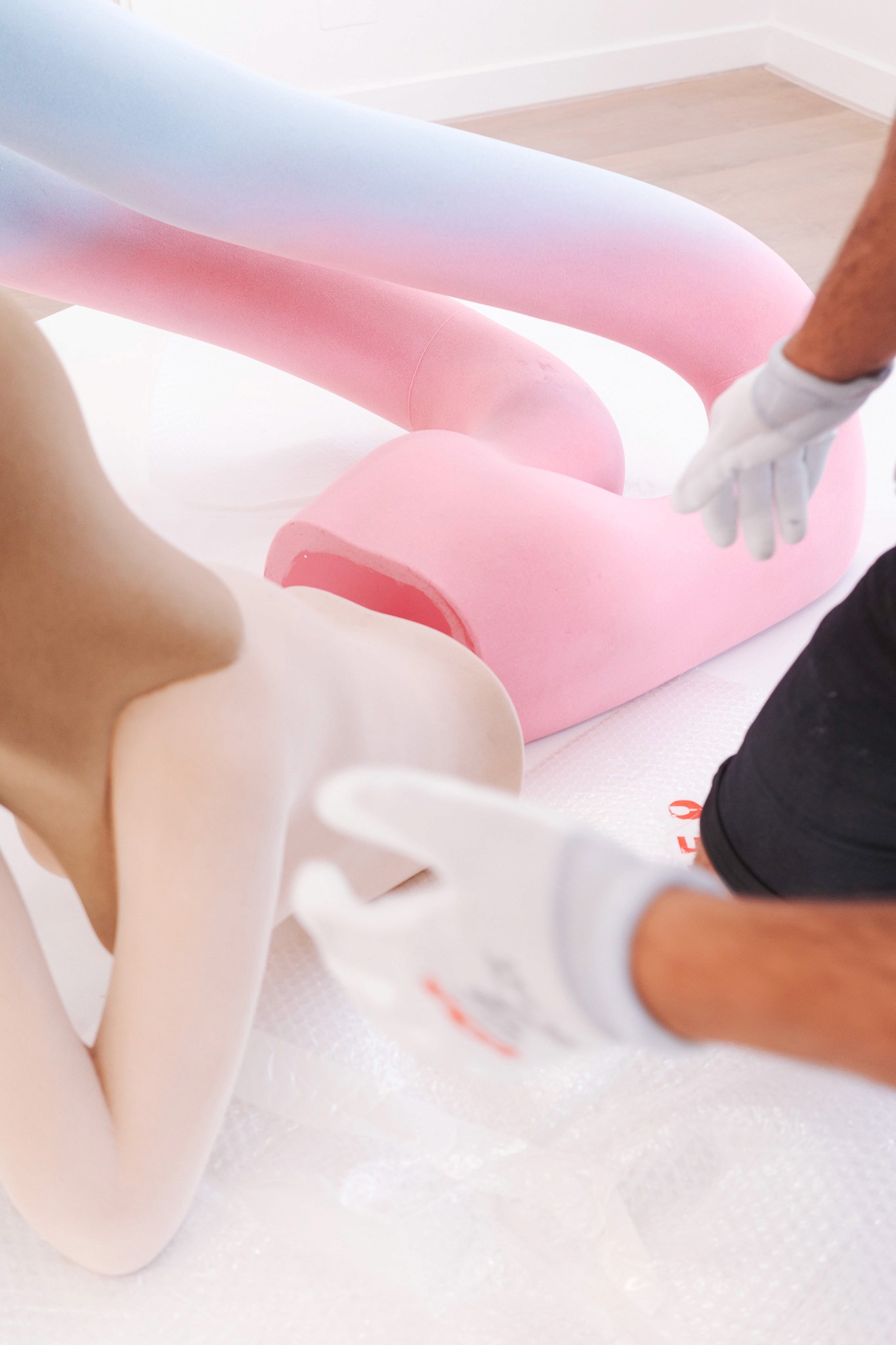
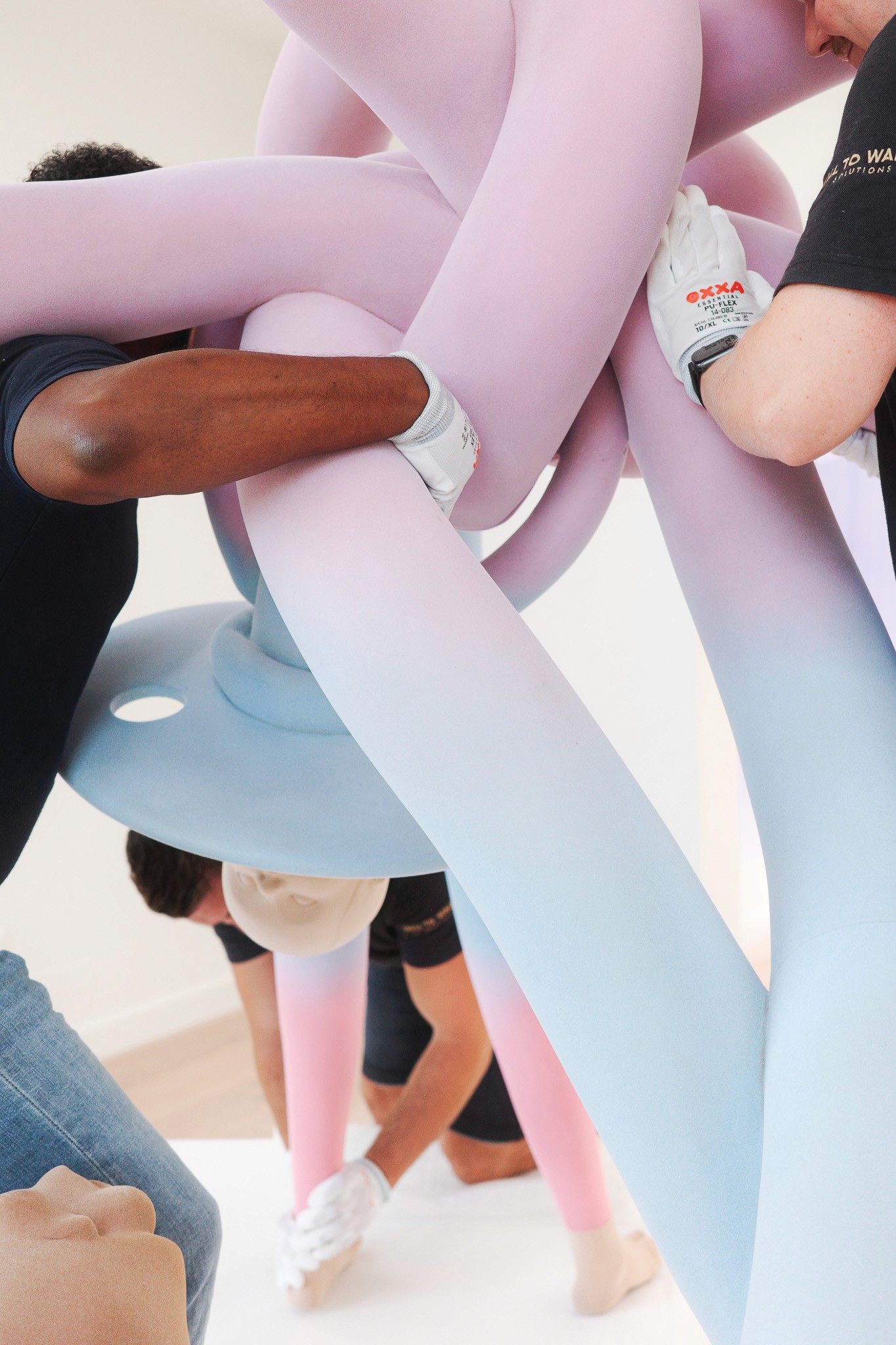
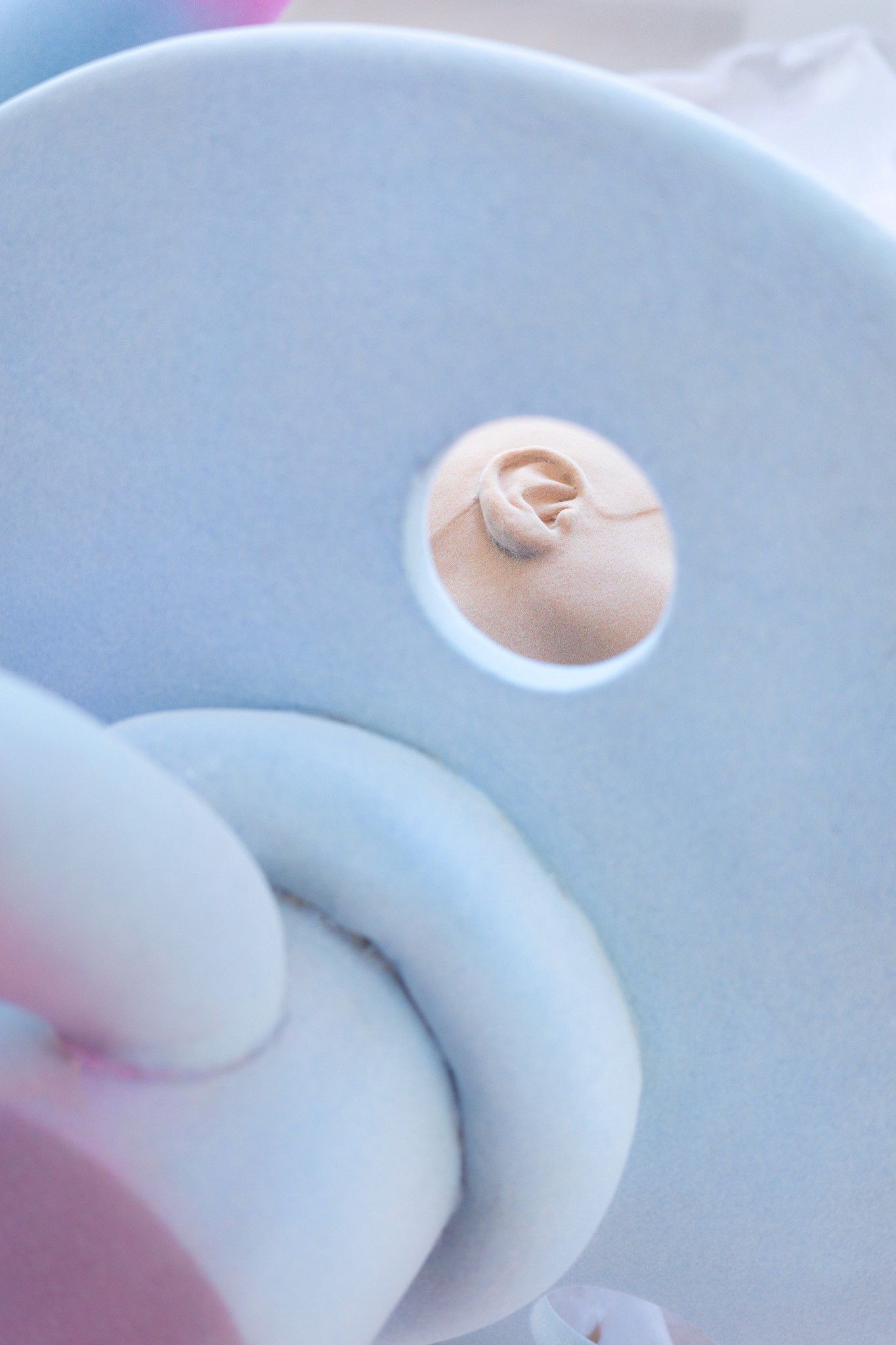
Across the installation, Vera’s large-scale sculptures and commanding paintings take on a monumental physical presence. Enormous sculptures and pontifical paintings in a palette of candy colours and ribbon-like shapes initially appear sweet, but carry sharp undertones. For Vera, painting functions as a time machine: historical motifs collide with video game aesthetics, creating a visual language that is playful yet urgent, and deeply life-affirming.
“I want to create something that immediately appeals to the viewer, but also contains a deeper layer. The colors and forms first grab attention, but a second look reveals more beneath the surface.”
Through this work, Vera interrogates femininity and societal expectations with a balance of humor and critique. Her iconic female figures parody beauty ideals and the pressure placed on women to conform to every role at once. Vera’s work feels girlish yet serious, light yet weighty. In this tension, she examines what is labelled as feminine in contemporary society – and who gets to define it.
Trivia
If you look up the titles “Portrait of Carl van Vechten, Florine Stettheimer” and “The artist and her model Geneva, Marie Louise Breslau”, you can see the art historical references the two paintings are based upon.
Vera’s sculpture weighs 140kg, and has to be assembled in three parts by at least three people!
About Vera Gulikers
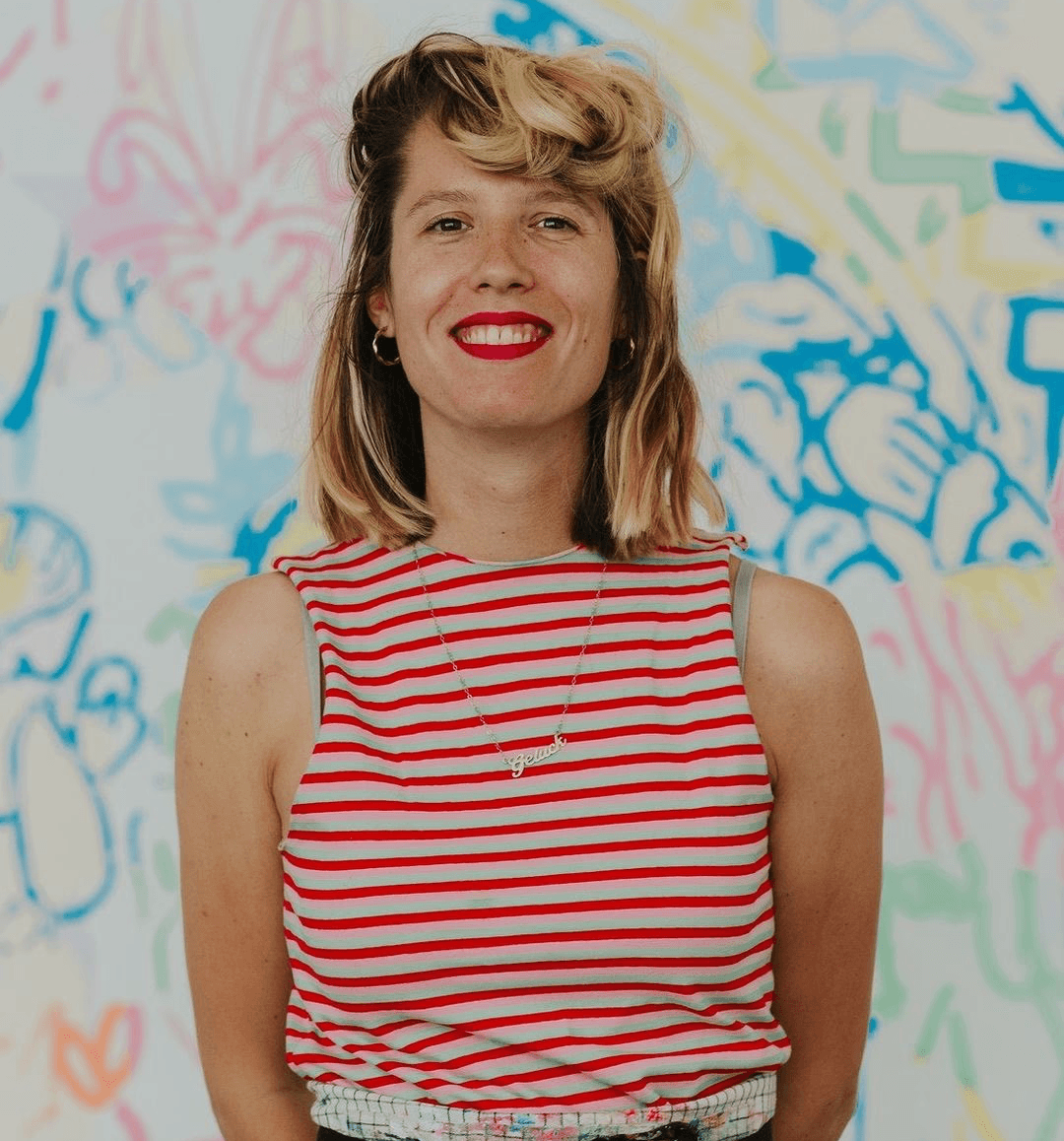
Vera Gulikers (1991) works in painting and sculpture, constantly stretching the boundaries of what we call feminine. She examines the medium of painting and its relation to so-called ‘female’ conventions. She blends historic techniques like egg tempera, fresco, and embroidery in combination with unexpected materials, like couture textiles, cleaning products, and interior finishes. Her work questions what painting is and what it could be – transforming tradition into something alive, tender, and quietly radical.
Vera lives and works in Maastricht. She was a resident at the Jan van Eyck Academie (2019), and received the Royal Prize for Modern Painting for her Poets- en Testdoeken (2019).
From Two Bodies to One
Over het werk van
Vera Gulikers
In 1899, Arletta Jacobs wrote the book De vrouw. Haar bouw en haar inwendige organen (The Woman. Her Structure and Internal Organs). With fold-out plates drawn by Jacobs herself, the book describes the female body in detail, including the reproductive system. Its primary goal was to explain how reproductive organs function to the growing number of women who no longer wanted their own sexuality to feel mysterious.
She studied the various stages of the pregnant body, partly through paper sculptures of wombs containing progressively larger fetuses. These were made by the groundbreaking company Auzoux, to scale and carefully painted. At the Venice Biennale in 2022, these paper wombs were exhibited alongside Jacobs’s fold-out plates, among contemporary artworks. Jacobs’s persistent spirit in her political and scientific struggle deserved recognition.
Where the 2022 presentation centered on the pregnant womb, Vera Gulikers, in her recent 2024 sculpture The Mother (The Bobby in Me), focuses on life after birth. At Villa, we see a figure with rollercoaster-like legs transformed into a bow, from which hangs a large pacifier with a baby’s head attached. The work embodies the physical transition from one body to two. According to Vera, this is a profound change, inherently connected to the process of letting go. At the same time, she experiences motherhood as a gift that keeps unfolding. In the sculpture, the faces of mother and daughter are close together; they meet each other’s gaze, yet there is literally a space between them. In this way, the layered emotions surrounding motherhood take on a physical form. In a video fragment from Museum Beelden Aan Zee, she explains that she also wanted to create this work to place the mother figure on a stage, thereby raising broader questions about how we view the role of motherhood.
Girls and women
In all her paintings and sculptures, Vera seeks out the girlish and the feminine in art. She does this, for example, by playing with paintings that at first glance resemble abstract expressionist works like those of Jackson Pollock or Willem de Kooning—macho artists who entered the canon like rock stars. In these abstract paintings, she incorporates subtle colored lines drawn from works by female artists from art history. So if you look closely, you see not an abstract expressionist painting, but figures celebrating women’s contributions to art history. It looks abstract, but it is essentially very figurative. Vera finds this reversal interesting. From an abstract visual language, the viewer encounters figuration, and in her work the opposite also happens. Her figurative sculptures originate from the idea of solidified paint. In an interview with Brigitte Bloksma, she says:
"I’ve been painting grid canvases for several years, always including a doodle inspired by a work by a forgotten or overlooked female artist from art history. At some point, I wanted to be able to walk around that doodle, to experience it from different brushstrokes, in space. I see my sculptures as paintings, as an extension, a kind of solidified paint. Even if practically it is very different to make. When you paint a lot, you almost feel like becoming a brushstroke yourself, like a self-portrait."
Her play with clichéd images of femininity also appears in her choice of materials, such as embroidery grids as painting surfaces and the use of a cleaning cloth as a brush. In the Poetsdoeken (Cleaning Cloths, 2017–2018) series, she blurs the boundary between art and domesticity. For these paintings, she used Vanish Oxi Action and other everyday cleaning products to rub away layers of egg tempera. In doing so, she shows that cleaning and painting not only share physical similarities but can essentially be the same act.
Use of color
Vera’s sculptures invite you to touch and even “taste” them visually, thanks in part to their swirling forms and pastel tones. She explains:
"Using pastel colors is a typical example of my approach: I experiment and only stop when I recognize myself somewhere in it. At the academy, I worked a lot with plaster and wanted to make some brightly colored sculptures. But during the process, the colors dried lighter and lighter, ending up as pastels. I liked it. The attraction of the colors draws the viewer toward the references underneath."
That is important to Vera—she wants to attract the viewer to then access a deeper layer. "I want to create something that immediately appeals to the viewer, but also contains a deeper layer. The colors and forms first grab attention, but a second look reveals more beneath the surface."
In an interview with Persis Bekkering for Mister Motley, she was asked whether her use of color also appropriates values like sweet, cute, or girly. She admits that it does, but also as an ironic commentary. She wants to play with the girly cliché and challenge stereotypes. "But I also really love the colors. Is that a social construct, something I grew up with? Is it because I am a woman? I explore that. A male teacher at the academy was completely disgusted. He said, ‘It leaves a bad taste in my mouth; can’t you stop?’ Such an extreme reaction interested me. I realized those colors could be a form of protest."
[1] https://www.youtube.com/watch?time_continue=154&v=sjqTNHRZGTg&embeds_referring_euri=https%3A%2F%2Fwww.de-lage-landen.com%2F&source_ve_path=MzY4NDIsMzY4NDIsMzY4NDIsMzY4NDIsMjg2NjY
[2] https://www.beeldenaanzee.nl/files/documenten/260924_bijlage_nrc_sk_04-05.pdf
[3] https://schunck.nl/museum/nieuws-en-verhalen/kennismaken-met-vera-gulikers
[4] Idem
[5] https://www.mistermotley.nl/de-meest-onbevangen-schilderstreek-een-interview-met-vera-gulikers/