EN

In the depths of memory
by
Levi van Veluw
Lured in by the pulse of a heartbeat, this space leads you In the depths of memory (2024). At the end of the earth-toned hallway, a film shows Levi van Veluw obsessively forming clay busts – moulding his self-portrait, again and again. This endless repetition is reminiscent of the myth of Sisyphos, tirelessly pushing a boulder uphill.
The physical result of this performance is the cylindrical dome behind you, where the same sculptures, arranged with ritual precision, seem to multiply infinitely. The atmosphere is charged: controlled, meticulous, and almost alive with tension. Disorientating, almost. It feels like a prison – or perhaps like Levi's own mind.
Year | 2024 |
Type | multidisciplinary installation |
Material | a.o. clay, wood, mirrors; videolength 15:25 min |
Work in Progress
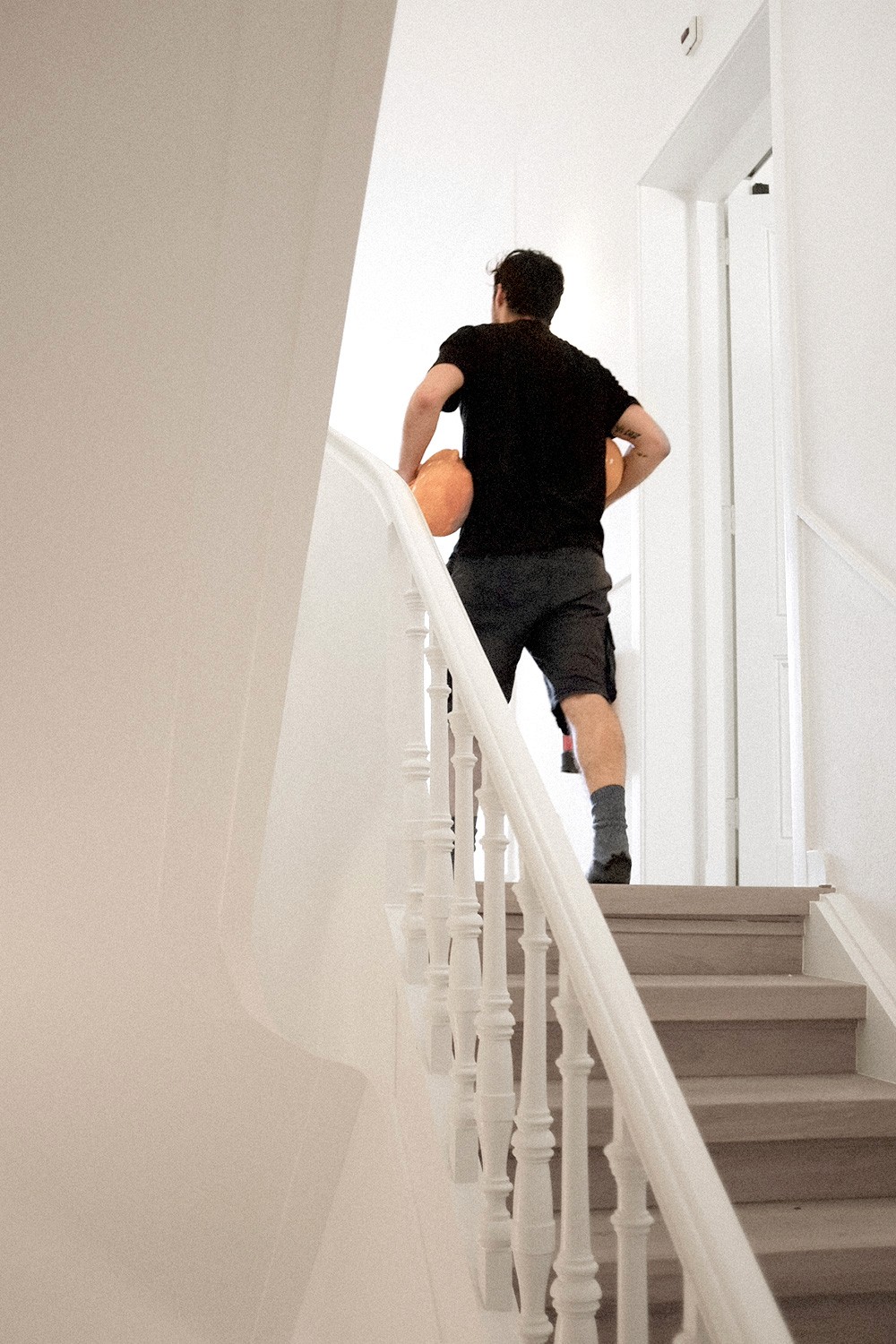
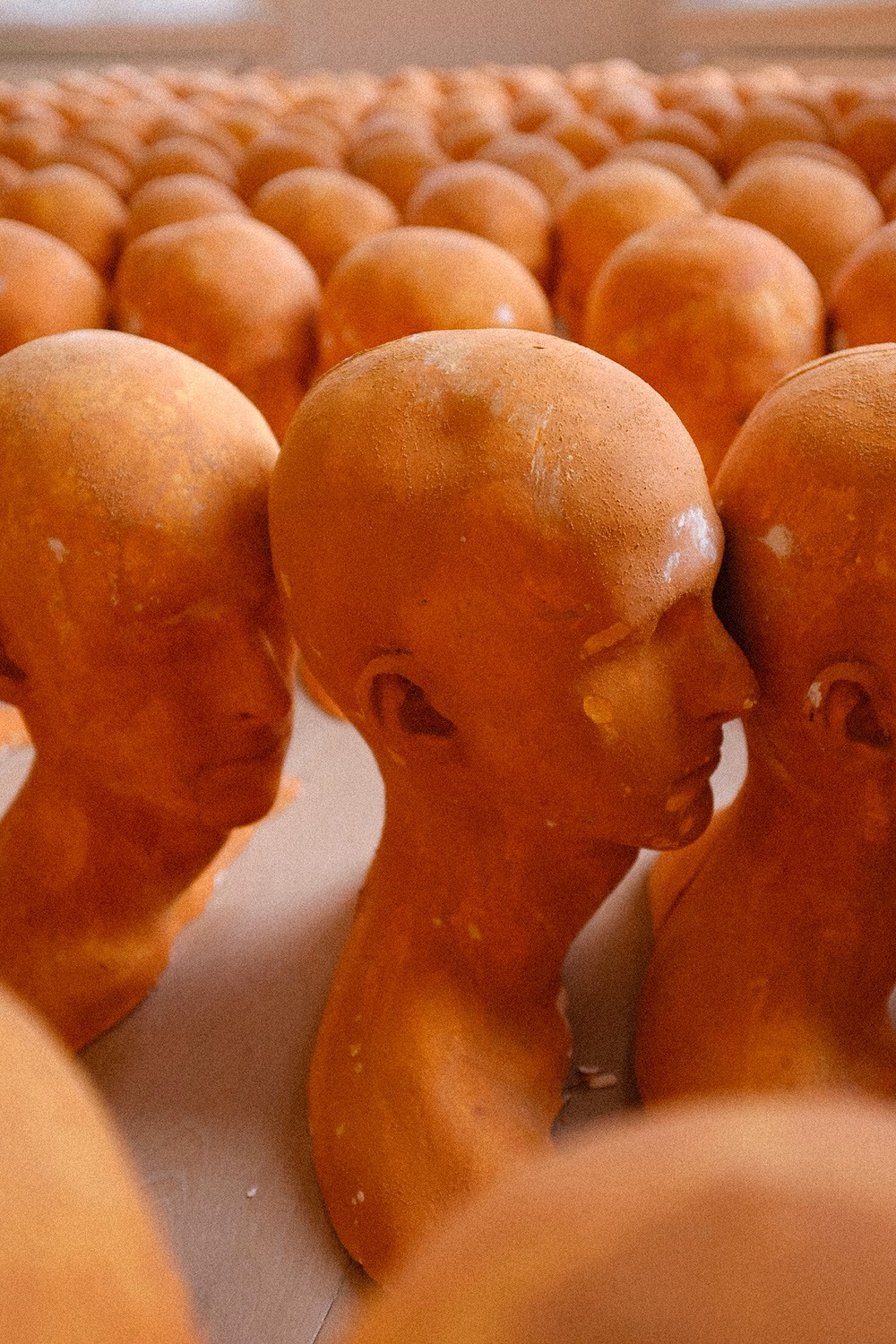

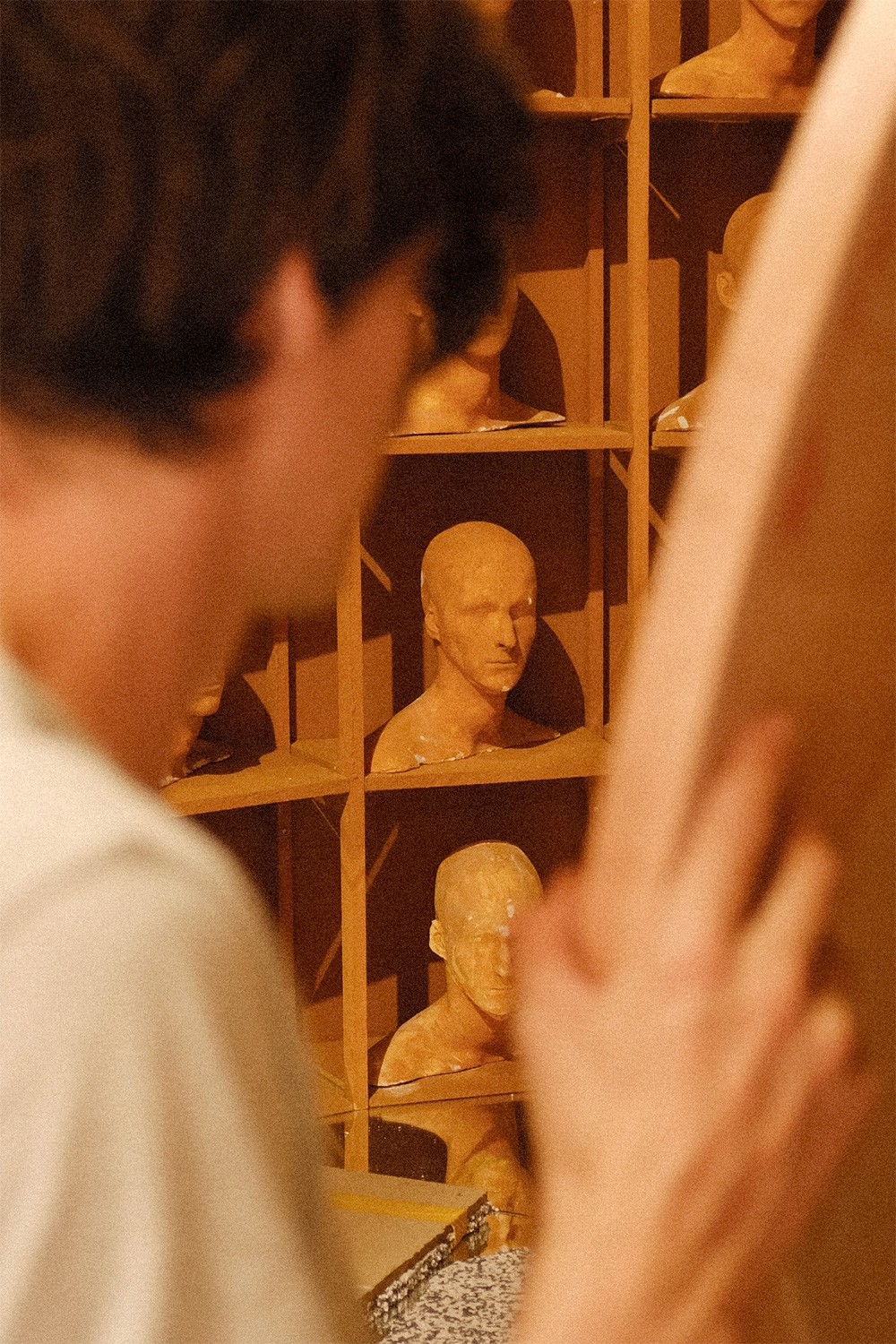
Levi draws inspiration for much of his work from childhood memories. A recurring theme is his religious upbringing, and the ritual objects and symbolism religion uses. He is fascinated by how these elements can evoke a spiritual experience in believers, even though Levi’s practice is deeply rooted in science. This duality manifests in the architectural grandeur of his installations, where memory, imagination, and perception collide. This room, too, is one in which to disappear, to feel insignificant – immersive like a cathedral.
“It is also a way of putting things in perspective. What is the point of putting all those images out into the world? What is the purpose of perfectionism in being an artist—where does it tip into obsession or narcissism? What is its actual value?”
Whether it concerns sensory installations like this one, or more graphic sculptures: Levi creates everything by hand with extreme care and craftsmanship. From clay and wood sculptures, over intricate charcoal drawings, to film and photography: his creations are precise, meditative, and deeply controlled. They are always made entirely by hand, demonstrating his craftsmanship. They reflect on the human urge to create, to preserve, and to leave a trace – Levi’s attempt at the impossible quest for immortality.
Trivia
Did you spot the window from the outside? For his longterm-installation at Villa, Levi constructed a window installation of his stacked heads, only visible from the garden – shining over Westerpark at night.
There are 450 of Levi’s heads present at Villa.
About Levi van Veluw

Levi van Veluw (1985) is a multidisciplinary artist working across installation, sculpture, drawing, photography, and film. Often appearing as the central figure in his own work, he uses self-portraiture and autobiographical narrative to explore perception, scale, repetition.
His background in photography is evident in his multidisciplinary approach – controlling light into an ominous, meditative atmosphere throughout his work. His diverse oeuvre has been exhibited internationally, including Paris, Milan, and Amsterdam. He has also worked in commission for Hermès and Audi. Levi lives and works in Zaandam.
The Inside of a Head
Over het werk van
Levi van Veluw
The artist is covered in sepia-colored clay. We watch him on a video screen. Hands, neck, jacket, ears, face, everything is made of clay. The clay-covered man is sculpting himself, with a pedestal in front of him. On it, he shapes his own face from the same brownish clay. The artist recreates his own head. Faster and faster, feverishly, he sculpts until the head is finished and he places it in a cabinet filled with countless other heads. Immediately another lump of clay drops in front of him; he begins all over again.
This video is part of Levi van Veluw’s installation In the depths of memory. When the visitor turns away from the screen, they face the circular cabinet with dozens of heads in Villa’s physical space. Once inside, it is dizzying. Mirrors on the floor and ceiling reflect the many heads into infinity. The work attracts and repels at the same time. The rhythm, the clay, the multitude feel perfectly ordered, yet at the same time the whole becomes claustrophobic and compulsive. Is Levi depicting here the weight of being an artist? The endless, almost obsessive reproduction of yourself for an audience, into infinity?
In an interview with Trouw, Levi says about this work: “It is also a way of putting things in perspective. What is the point of putting all those images out into the world? What is the purpose of perfectionism in being an artist—where does it tip into obsession or narcissism? What is its actual value?” [1]
With this installation, he questions himself, but also the artist’s role in a broader sense. Being an artist as a search for perfection and control. In that same interview, Levi explains that societal or political ideas are never his starting point in making a work; instead, he wants to create artworks suggestive enough that visitors may form their own perspective on the world. No agenda, but art about the things that unfold inside his own head. “It’s art about art. About the questions I have. Very introverted, that’s for sure.” [2]
Ordering chaos
The relationship between order and chaos recurs in many of Levi’s works. The series The Origin of the Beginning takes several forms: photographs, videos, and physical installations.
In one of the works from this series, a life-sized space is arranged with five people sitting around a table. Once again it is Levi himself, this time joined by his parents, brother, and sister. The table, the space, and all the people at the table are covered with dark brown blocks—20,000 in total. Once again, it seems to form a harmonious whole, a family seated at the table. But the overwhelming number of blocks also feels oppressive. A family at the table, sealed off from reality.
The endless blocks, like the many heads in Villa, are also a way to impose control on chaos. This series, of which this family portrait is part, is inspired by a recurring nightmare from Levi’s childhood. In it, countless marbles rolled around in patterns while he desperately tried to keep them together. Gradually they began to collide and spun out of control.
The desire to find control likely stems from his character, Levi thinks, but may also have to do with circumstances. His childhood plays a role especially in his earlier work, and in a recent interview with de Volkskrant he briefly opens up about it: “I always had an insecure home situation. Not just because my parents divorced—there was always unrest, sometimes extremely so. My mother’s parents were in concentration camps and traumatized by the war, and that carries on. As a child, you search for something to hold onto, you develop fears. Not to the point of dysfunction, not at all, quite the opposite. The odd traits you develop as a person can sometimes be very fruitful for art.” [3]
Craft
Levi became known for his photographic self-portraits between 2006 and 2010. In these images, his head faces the same direction, gazing past the camera into the corner, his face covered with different materials: miniature trees, pebbles, painted blocks, or strips of felt. His face as a living landscape. After this series, he avoided depicting himself for a long time and began working in a much more abstract way, until the installation now on view at Villa.
A common thread in the many photos, videos, and installations he has created over the years is the use of geometric patterns and grids: strips of felt on his face, 20,000 blocks in a room, or the 1,500 heads in In the depths of memory. Strikingly, all of these elements are made by hand. He could easily order them or have them machine-printed, but he chooses to craft each fragment of his work himself. He has tried to make parts of his work mechanically, but in his words, it then becomes “a dead object, without history or story.” [4] By making lines by hand, for example, they are never perfectly straight; each is slightly different, which, according to Levi, gives his works their soul. As if an energy is charging the work.
Levi’s grandfather was a minister, and as a child Levi often went with him to church. There he saw all kinds of religious forms, the architecture, the high building, the feel of the collection bag. He learned there that people give material shape to things that are vast and invisible. That you can make visible the things that take place in your head, in a space normally inaccessible to anyone else.
[1] https://www.trouw.nl/cultuur-media/de-geordende-chaos-in-het-hoofd-van-levi-van-veluw~b0970860/
[2] Idem
[3] https://www.volkskrant.nl/tentoonstellingen/kunstenaar-levi-van-veluw-krijgt-de-singerprijs-met-bijbehorende-tentoonstelling-hoe-ver-kunnen-we-gaan~bf2648ea/
[4] https://www.trouw.nl/cultuur-media/de-geordende-chaos-in-het-hoofd-van-levi-van-veluw~b0970860/