EN

Kant’i-Laman
by
Gilleam Trapenberg
On a large screen, a couple stands in a quiet embrace, looking over the horizon. Kant’i Laman (2025) will take you to the seashore of Curaçao, the island where Gilleam Trapenberg was born. Although he has photographed this beach many times – in this work he installs his subjects larger than life, in an everlasting loop, and accompanied by waves, voices, and subtle ambient sounds.
The moment is simple yet monumental. The work invites us to linger in a space between land and sea, intimacy and distance, presence and memory. It’s a poetic encounter with Caribbean life, shown not through spectacle, but with a quiet sense of honesty and vulnerability.
Year | 2025 |
Type | videowork |
Length | 11:13 min |
Collaborators | lan & Thandie, Noel Schoolderman, Alyssa van Veen, Vanessa Aparicio (Glassworks VFX), Artillerie, David Coehorst, Andrés Aracena, Rozaly |
Projected at a monumental scale, the scene fills the room. You don’t just watch the couple – you look up to them. Gilleam employs the Heroic scale, a format historically used in painting, enlarging figures to 1:1,2 proportions to give them grandeur. Yet the couple's interaction feels effortless, unbothered by the world around them, or the world observing them.
“I want to make portraits that are not theatrical, that do not perform for the viewer. I want to make work that stays with the place, its pace, its calm, its people.“
Originally included in an advertisement commissioned by Amsterdam streetwear brand Patta, the clip stayed with Gilleam beyond its original context. It continues a series he has been developing on this same beach since 2023, in which the viewer gets to gaze at the sea alongside the subject. So far, the series has consisted of photographs, in this case Ian & Thandie are recorded on video. Gilleam presents a soundscape created by David Coehorst and Andrés Aracena, using recordings from the island of Rozaly.
Trivia
Kant’i-Laman is a phrase that translates most literally to Edge of the sea in Papiamentu, the creole language spoken in Curaçao, Aruba, and Bonaire.
You don’t just watch the couple – you look up to them. Gilleam employs the Heroic scale, a format historically used in painting, enlarging figures to 1:1,2 proportions to give them grandeur.
About Gilleam Trapenberg
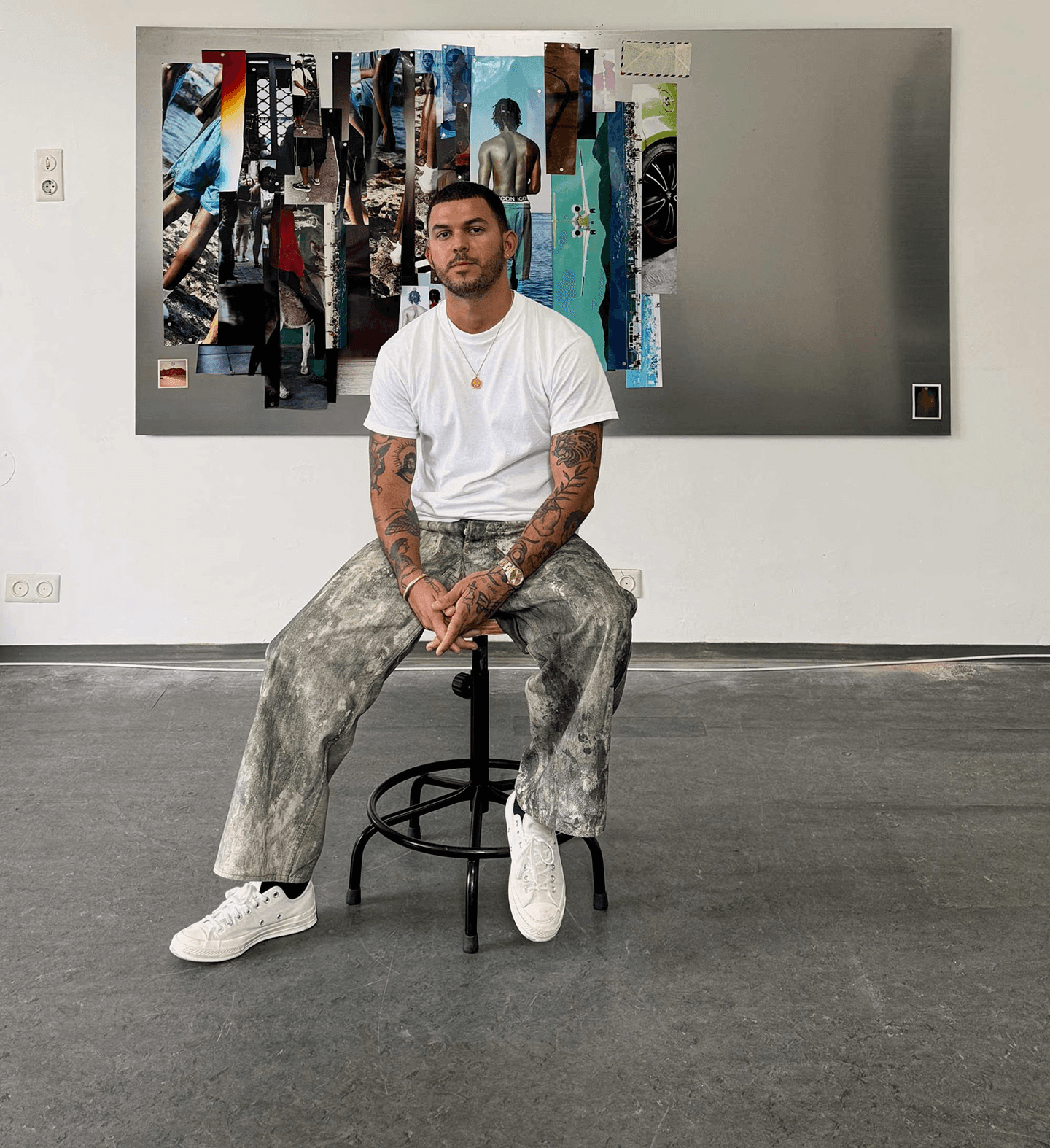
With his work, Gilleam Trapenberg (1991) investigates the paradoxes of the Caribbean and challenges stereotyping and cultural misrepresentation, especially as shaped by Western media. He focuses on local residents and everyday moments and invites you to see the island as intimate, vibrant and layered. His photography and video balance between documentary and dream, showing the reality of colonial history, mass tourism and daily rhythms.
Gilleam first moved to the Netherlands at 19 years old. He lives and works in Amsterdam, but regularly returns to Curaçao. Since graduating from The Hague's Royal Academy of Art (2017), his work has been exhibited at institutions such as Foam (2021), Stedelijk Museum Amsterdam (2020), and the National Portrait Gallery London (2023).
Memories of an Island
Over het werk van
Gilleam Trapenberg
They wear the same kind of sandals. Just strong enough for the rocks they stand on, but open at the back so the passing sea breeze cools them. Gilleam Trapenberg filmed a young couple on a small volcanic beach in Curaçao. Arms wrapped around each other, they stare out at the sea. Her neck fits into his shoulder, his hand reaches her upper arm. People often say that love is about where, and on whom, you can rest your head.
This rocky beach, where the sea breaks over the stones, means a lot to Gilleam. He discovered it while growing up in Curaçao. Later, it became a place to clear his mind when he visited the island from Amsterdam. Over time, he started noticing people in that exact spot. “Just sitting, looking out, being there.”
The two gaze at the horizon, at the world beyond the island. What they think remains a mystery. Gilleam often captures people from behind: with the sun at their back, their faces turned toward the sea and the European continent. We, the viewers, look along with them.
Curaçao
Throughout his artistic practice, Gilleam records his personal experience of life in Curaçao, the place where he was born and raised. He combines personal memories of the island with an observant eye to make the essence of Curaçao tangible through its people and their surroundings. He mainly photographs the inhabitants and the way they live. The video work at Villa continues a series he has been developing on this same beach since 2023. “What began by chance has grown into a larger project about collective memory, desire and representation.” Alongside images of the young couple, Gilleam presents a soundscape created by David Coehorst and Andrés Aracena, using recordings from the island of Rozaly.
What drives that observant gaze? The artist finds it important to go beyond the tourist clichés of the island. “A large part of my work is about creating counter-images, showing a different kind of Caribbean that is closer to how I know it. I want to make portraits that are not theatrical, that do not perform for the viewer. I want to make work that stays with the place, its pace, its calm, its people.” In his images, you see a romantic view of the island. He now lives in Amsterdam but often looks back with longing to the place where he grew up. That longing shapes his images: the warm light, the deep colors, and people genuinely connecting with each other.
In 2022, Gilleam was interviewed by Luuk Heezen for the podcast Kunst is Lang. At the end of the conversation, Heezen asks the photographer: what is actually the difference between the romantic gaze and the exotic? In other words, photos by him versus those from famous fashion campaigns on white Caribbean beaches with interchangeable bodies. Or the slick Instagram images of bright blue seas, palm trees, and colorful cocktails. Images entirely polished. Photos that still carry a colonial character: the island and its people are not depicted as they really are, but as objects meant to please wealthy, white Westerners. “In the romantic gaze, there is a certain love and understanding,” Gilleam replies. “To give a photo a romantic layer, you need to know something about what you’re photographing. My images are about longing, but you can’t miss what you’ve never known.”
The Sea
71% of our planet is covered by oceans. When children see the sea for the first time, they often do not understand what they are seeing. A kind of giant bathtub without edges. For Gilleam, the sea plays an important role in his work. Surrounded by it as a child, the salty water is part of the identity of island inhabitants. The sea also connects Curaçao to his current home, Amsterdam. The sea symbolizes dreams. Those who look at it think of the world beyond, of another life that could be lived. But it was also the sea on which the Dutch West India Company transported enslaved Africans from 1634 onward. Curaçao was used as a transit port, where enslaved people were traded and sold to other colonies.
By depicting people looking at the sea, Gilleam gives it a central role in his images. He allows viewers to look over the shoulders of the subjects toward the ocean. Towards that water, which has always played a fundamental role in the island’s history and therefore in the minds of everyone on it. What happens on the other side?
In the same interview with Luuk Heezen, Gilleam states that he could never have made his current work without moving to Amsterdam. Distance from the island allows memories to flow. Without those memories, his artistic practice probably would not exist. The Bulgarian writer Georgi Gospodinov writes in A Shelter for Other Times: “The past is fundamentally different from the present in one way—it never flows in a single direction.” And that is true: in the here and now, everything moves forward. Everyone ages and moves forward in time every day. Events from the past are like a kind of soup. They no longer exist in sequence, are blended together, and can always be brought back to the here and now. Sometimes, just seeing a sunset softly fall on the shoulders of a boy and girl is enough to evoke the past.