EN

Reflection 1.0
by
Elsemarijn Bruys
In Reflection 1.0 (2024), you'll be instantly confronted by yourself in a distorted version of the room. The scene shifts slowly in the large kinetic mirror in the centre of the space and seems to pull reality completely apart. The tall blue Columns (2025) act as anchors to reality – straight lines to rediscover in the warped reflection. Elsemarijn Bruys invites us to confront how reality is shaped by perception, until distortion feels not unsettling – but beautifully real. The space is transformed by Elsemarijn, letting the sunroom of Villa dance in blue light.
Title | Reflection 1.0 |
Year | 2024 |
Type | installation |
Material | plexiglas, aluminium frame, motor |
Title | Column |
Year | 2025 |
Type | sculpture |
Material | plexiglas, aluminium |
Work in Progress


Is it moving? Can it be glass? Could it be plastic? Elsemarijn is a master of deception. To her, truth is always a construct. Something material which Elsemarijn pushes to the limit relentlessly and joyfully. It’s bold. It's clever. You’re not just a visitor – you become part of the work.
“When I see my own work, I feel like touching it. I actually don’t want to, because fingerprints stay forever, but at the same time I want people to come close. In the sculptures you can observe yourself, but also the other, through the reflective materials I use. That voyeurism fascinates me. Who is looking at whom?”
Her work revolves around the interaction between visitor and environment, as well as between people themselves. Elsemarijn draws on principles from Minimal Art, an art movement from the 1960s in which not the artwork but the (museum) space – with its values and context – takes center stage. Her interventions are both theatrical and subtle. Maximum effect with minimal intervention. Working with air, reflection, and illusion as material, Elsemarijn creates immersive environments that sharpen perception and playfully distort the relationship between body and space.
Trivia
Elsemarijn has assembled this work in reaction to this room, which we like to call the “Sun Room” since there is so much light. You should see it on a sunny day, everything is reflecting and glowing blue.
The choreography of the mirror warping is programmed in 11 steps, with a duration of six minutes in total.
About Elsemarijn Bruys
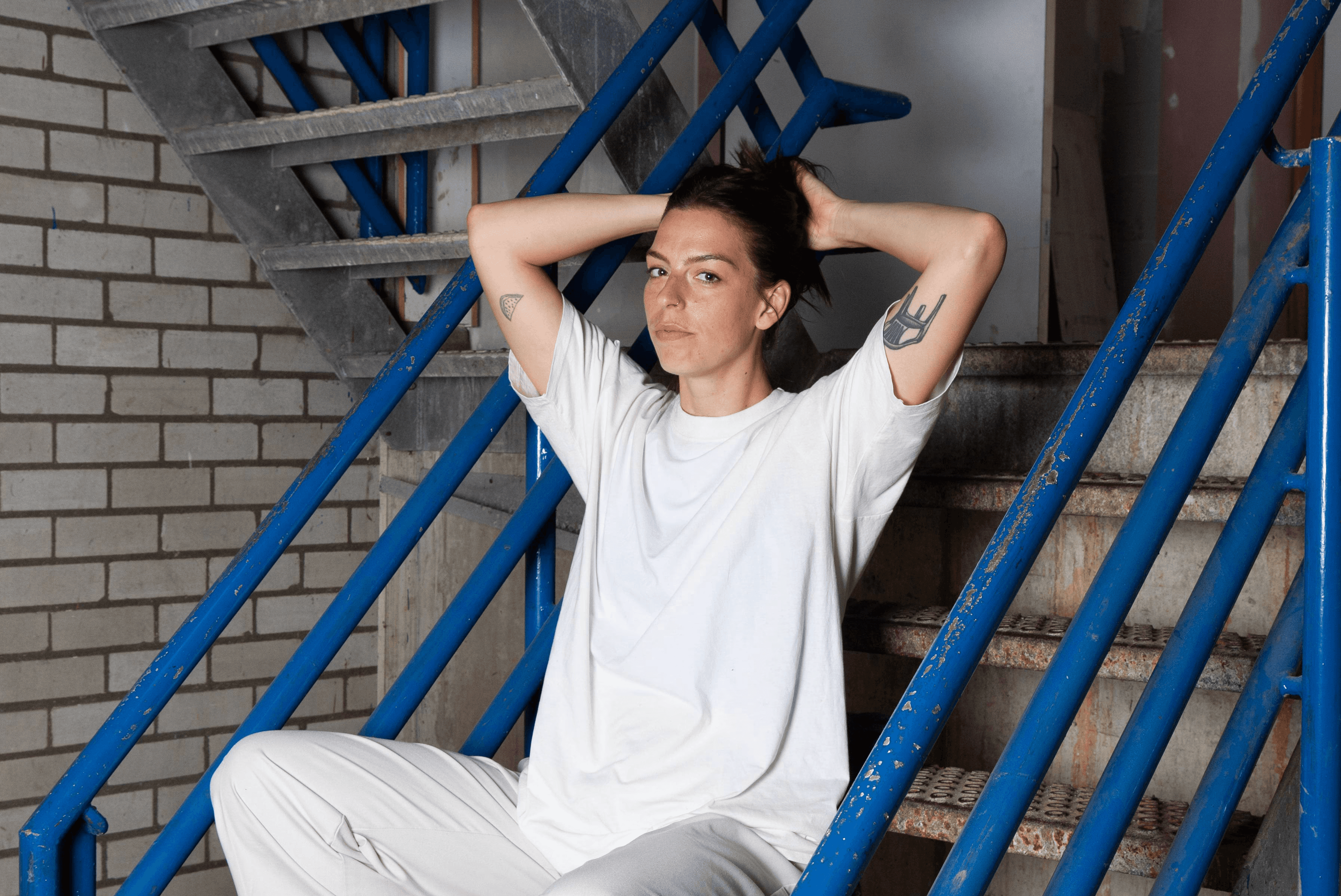
Elsemarijn Bruys (1989) plays with how we see and experience. Her multidisciplinary installations exist in the in-between: mirrors distorting surfaces, glass filtering light, inflatables filling a space to the brim. She manipulates sensory perception through sculptures, installations, and architectural interventions – focusing on the relationship between the viewer and the space. Air, reflection, and the intangible are made material. She’ll confront you with yourself and your presence in the room.
Elsemarijn lives and works in Rotterdam. She studied Fashion Design at the HKU (2013), where her graduation work explored the sculptural and social dimensions of the puffer jacket. The work of Elsemarijn is presented both in the fine-art context like at Stedelijk Museum Schiedam, Nest The Hague, and Van Gogh Museum Amsterdam, as well as beyond institutional walls with interventions at music festivals, such as Down The Rabbit Hole (2017) and Best Kept Secret (2025).
What is real?
Over het werk van
Elsemarijn Bruys
A mirror is not only an object that shows us our appearance: when we look into it, we see the world reflected, with ourselves at its center.
Artist Elsemarijn Bruys has created a new installation in Villa where reflection plays the leading role. On the wall hangs a mirror that slowly moves forward, like a door opening and closing in its frame. In the same space stand several pedestals holding elongated blue sculptures. As the mirror shifts, not only does the reflection of the viewer change, but so do all the blue objects around that body.
In spring 2025, Elsemarijn presented her solo exhibition MINIMAL ART ON ACID at the Stedelijk Museum Schiedam. There she transformed the attic of the museum into a disorienting world with one large moving mirror, sliding from the front of the attic floor to the back. The wooden beams of the attic were completely distorted in this reflection. For Elsemarijn, these warped beams were a gift. So when she received an invitation from Villa, she wanted to take this effect further. “Not only to let you see yourself distorted in the mirror, but also to make something else in the space move along.” By adding posts to her installation, she emphasizes the motion of the mirror. Much of her work deals with this interplay between different objects: they need one another to transform, through reflection, mirroring, or movement.
Square
Recently she discovered that many of her works originate from a square that is then manipulated. The blue sculptures at Villa were created by vacuum-forming sheets of plexiglass. These sheets started as squares. Her Puff sculptures are another example: flexible square plastic sheets that are stitched into soft, voluminous forms. The end result breathes lightness and motion, with no trace of the original square left.
In daily life, Elsemarijn pays close attention to rhythm and proportion in objects. The grill of a truck, for instance, and the way its lines form a pattern. Rhythm matters to her. What is the order of objects in an installation? How many objects are shown? What rhythm, what pattern do they create together? In this sense, a mirror is an intriguing choice. By placing a mirror, she can manipulate the perceived rhythm or arrangement of objects. “With a mirror you raise the question of which reality is supposedly the real one. And more broadly: does something like ‘real’ even exist?”
In Phenomenology of Spirit (1807), Hegel used the mirror as a metaphor. For him, seeing yourself in the other (as in a mirror) was a process of recognition: you become aware of yourself because the other acknowledges you as a conscious being. The mirror serves here as an object confirming that you exist. Something like: I see my reflection, therefore I exist. Plato, on the other hand, saw reflections as images of the true reality, but not reality itself. For him, a reflection was always a copy, and therefore less real. In her work, Elsemarijn constantly stages this tension between the two extremes. What is reality? Can we take what we see as truth?
Tracing back
The blue plastic objects transform the light entering Villa’s space. That light is then reflected again by the moving mirror. In Elsemarijn’s work, you can always see how she manipulates reality. You notice the mirror moving back and forth and warping the view, or the bent plastic altering the sunlight that falls on it. This openness about how the work is made creates a charged experience. You know she controls everything, and yet you let yourself be carried along. That stands in sharp contrast to something like social media, where you know you’re being manipulated—but the question remains: how, and to what extent?
Her sculptures often appear inviting: shiny, smooth, rounded shapes. “When I see my own work, I feel like touching it. I actually don’t want to, because fingerprints stay forever, but at the same time I want people to come close. In the sculptures you can observe yourself, but also the other, through the reflective materials I use. That voyeurism fascinates me. Who is looking at whom?”
Responding to each other
Elsemarijn’s works often respond to one another. New pieces almost always grow out of insights she has gained from earlier ones. Like the attic beams in Schiedam that led to the sculptures in Villa.
Elements of her duo exhibition Open Field with Femke Dekker in Nest in 2024 also echo in this installation. That show featured two imposing mirrors that slowly rotated on their axes, reflecting not only visitors but also the architecture from ever-changing angles. The installation was first shown in an old factory hall (the temporary home of Nest), but Elsemarijn hopes to present it again in a white space. Architecture always influences how her work is seen. In a white museum hall, the rotating mirrors would place the focus more squarely on visitors themselves, since the space would interfere less.
Her practice recalls the children’s game of telephone: each time a word is whispered along the circle, something of the original remains, but something also shifts. At the end, a completely new sound emerges. A phrase never heard before, yet still traceable to its origin.